Pages

Showing posts with label revolution. Show all posts

27 February 2015

And Then The King Fell

"Gogo tell me a story", Mandla piped up in the failing light. His voice piercing through the gathering darkness with all the innocence and insistence that only a seven year old has.

Gogo stirred from whatever depths of thought her mind had descended to. For a moment she seemed as if she hadn't heard the question, her face expressionless, a calm sea upon which a wave of laughter burst. She cackled for so long even Mandla began to worry that finally Gogo had finally lost the last of her wits as mama said she would. Mama did not really like this Gogo that much, Mama liked the Gogo who was her mother and not this one who was Baba's mother and spent her days wrapped in her silent thoughts. 

"You want a story do you?" Her voice was strong but breathy. The question hung in the air for a moment before she went on. "You want a story and I will tell you one, I will tell you a story of a King, powerful and royal. A King who mounted the world and thought the Sun revolved around his balls".
Mandla giggled, he liked it when Gogo was in this mood, he knew the story would be good. He stood up and went to snuggle against her, his eyes closed and very soon his whole world was Gogo's voice. Gogo's powerful voice weaving its threads through the darkness. 

"Once long ago, long long ago back when the stones were still soft and snakes had legs; long ago when Elephant's nose had not yet been stretched by Baboon and Cheetah had not painted with spots by Hare. Long ago in this very land lived a powerful King who ruled his country with a stone fist. His people were the saddest in the land and yet their lands overflew with maize and their rivers with gold. They could not speak because the King did not like anyone but himself to speak, for he thought his voice was the most amazing thing in the world. They could not think for the King felt that only his mind held anything of interest. And while his family were the fattest in the whole grasslands, their skin soft like that of the plum in summer and their hair black and shiny like the inside of a Mamba's mouth; his people starved, their stick-like figures standing like praying mantis' in the harsh glare of the light of day.
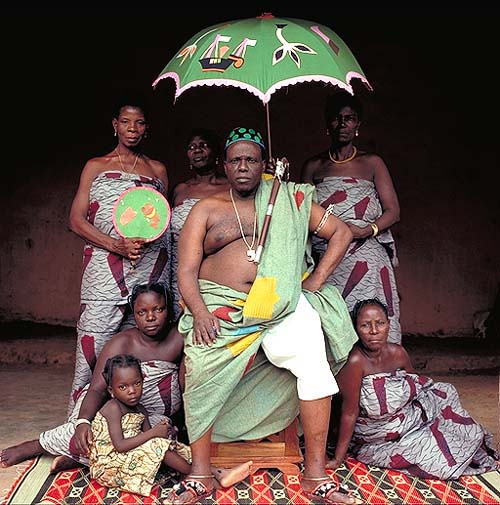
"while his family were the fattest in the whole grasslands..."

People came from far and wide to this land to trade gold with this King, and precious stones and maize. They came from the Northern lands where the sun shines all day and rests only for an hour before rising again. They came from the East where the jungles are so deep and dense demons live in the darkest corners of that land. They came from the West where they worship fish yet eat them more than anything else. They came to trade and the King and his family grew fatter and richer than all the lands that had come before and all the lands that were to come after. Or so they thought."

Here Gogo paused. The Sun had now set and the smokey interior of the hut was now completely dark. But she didn't motion to Mandla to look for the candles so he stayed snug and calm in her embrace.

"No one knew how it happened but those who served the King became blinded by his wealth. Perhpaps it was the sight of the gold that dripped from his body, or perhaps they were blinded by the gleaming rolls of fat that rolled off his fat belly. Some say it was the witches of the West who had been bribed by the King's diamonds who bewitched them but soon the entire land was bewitched."

Gogo's voice grew dark and heavy, punctuating the hut, reverberating against the mud walls and making Mandla grip tighter into her shawl.

"They grew crazy, worshipping the ground he walked on. What little food the people had, they gave to the already fat King to celebrate the day of his birth. One time in the middle of a drought, they slaughtered so many cows and goats, the waters of the River Nkawe turned red for seven full days and seven full nights. Even as the people slept under stars for lack of homes, the King built more and houses for him and his Family. While his people walked, the King used the gold of the land to buy horses from the strange lands of the North. While the children of the people went to sleep hungry, the King used the silver of the land to buy fish from the lands of the West; smoked fish, spiced fish, dried fish, fish aged for centuries in the ageless storerooms of the Western people and whose taste is said to be unrivalled by anything under the sun. Whenever he spoke, his Royal Servers would drop to the ground and thank the heavens for having been blessed with such Knowledge. Whenever he would deign to look at one of them they would freeze, afraid of upsetting the balance of the Universe if they made one wrong move in his presence. Very soon they began to call him not only their King but also their God". 

Gogo spat out that last word with such vehemence she began coughing. Her rough heaves felt painful to Mandla but he sensed a deeper pain in her. He clutched tighter to her side, afraid the King would materialise in the hut and bewitch him into thinking of him as a God. Gogo was silent for so long, Mandla feared she had fallen asleep. 
"What happened next Gogo?", his voice was now plaintive, "what happened to all of them". 

To Be Continued....


10 March 2013

If I could, I wouldn’t: Five reasons I wouldn’t vote for the Draft Constitution


We the People of Zimbabwe...

It begins with so much promise, so much hope but somewhere along the way it teeters horribly towards the edge before catching itself in its skirts and tumbling into an oblivion created by its own self contradictions. The Zimbabwean ‘Final Draft’ Constitution which has taken several years and an obscenely large amount of money to create fails to live up to the task that its creators and the people of Zimbabwe had set upon it. Its genesis was mired in controversy and this less than auspicious birth is reflected in its one hundred and seventy two pages.


As a Zimbabwean living in the diaspora I have also been alarmed by the complete lack of information surrounding the document. Many of my friends had never seen the document let alone read it. Many did not know what the fundamental differences between it and the Lancaster House Constitution it was replacing were and yet more did not have the slightest inkling of an idea what its implications were.
So out of the infinite goodness of my heart, I have summarized my top five biggest gripes with the ‘Final Draft’ Constitution. Comment is free so let’s talk about this document that is supposed to dictate the direction that the Zimbabwean sovereign experiment will take.

1.       Process, process, process
My first issue with the document itself has nothing to do with the document itself but the  way it was crafted. For those of you who follow Zimbabwean events, the Zimbabwean government spent millions of dollars reaching out to the Zimbabwean populace, trying to get their views on what they wanted in a new Constitution. At the end of all this information gathering what then happened? The two principal political parties bickered for months on end, grandstanding and posing, until they finally came up with a compromise ridden version that suited their needs.
Which begs the point, why ask the opinion of Zimbabweans if they opinion was not going to be of paramount concern ahead of the interests of Political Party X vs Political Party Y. Where were the civic organisations, the human rights groups, the universities, the Lawyers and the Intellectuals during the bickering phase? Where were the people of Zimbabwe? Oh yes, that’s right, their voice didn’t count did it.


2.      Executive President
The ‘Final Draft’ Constitution retains the post of Executive President amongst other things that should have been thrown out with the bathwater (more of that soon). The President is described as “the Head of State and Government”.
Most countries like the United Kingdom and Germany separate the two functions, for example David Cameron is the head of government and Elizabeth II is the head of state, François Holland is the Head of State and Jean-Marc Ayrault is the Head of Government. The reason in most cases is to split power and avoid vesting it in the arms of one person. In a country like the United States of America which combines the two, a complicated system of checks and balances is put in place to counteract the resulting concentration of power. Failure to do that means one person elects all Ministers, Deputy Ministers, Permanent Secretaries, Ambassadors, Chiefs, Judges of the Supreme and Constitutional Court, Commissioners of all entities whose function is to provide oversight of the Presidency…. The problem should be apparent.

3.      Retained too much of what was bad about Lancaster
In this section I include: an unlimited number of Ministries (Zimbabwe has almost double (40) the amount of Ministries than South African(25) despite having an economy a tenth of the size [USD550 billion versus USD6 billion], incidentally Switzerland has 7 Ministers), a Senate (again a matter of size), reserved seats in Senate for Chiefs (really? Why?), an amazing ability to grant a right then add a ‘but…’ several chapters down the line. A glaring example is the constitution’s lengthy declaration that men and women are created equal then several chapters later prohibit execution of female criminals under any circumstances (think about it carefully: a man could kill one person and be executed, a woman could kill an entire village of children and receive nothing worse than jail time). Others include property rights which are granted then curtailed for foreigners/descendants of foreigners whose land was “redistributed” (this also after a lengthy description that all citizens of Zimbabwe are equal whether by birth or descent) or in the case of the class of land identified as Agricultural Land which can be seized by the Government with no notice at all (contradicting a previous article), not compensation (contradicting another article to respect International Law [SADC law obligates a government to compensate the owner of the property for the value of the land]), and removing the possibility of the owner approaching the courts (which contradicts the article on the inviolability and supremacy of the courts).  

4.      Too much of what was talked about by Zimbabweans is missing
In this list I will include: multiple citizenship, voting rights for Zimbabweans living outside of the borders of Zimbabwe, retroactive application of some of the provisions of the Constitution (a controversial one I admit but still,,,we wanted it, we should have gotten it), protection or declaration of any sorts of LGBT rights (the writers decided to skip the issue entirely), an attempt (even a weak one) at decentralization of power from the centre….

5.     A compromised document no matter what you call it is a compromised document
It reflects that in its lack of defining anything. The “Yes…but” nature of it all. Government is tasked with protecting freedoms, “within the means available to it” (what are those means? Who decides what’s reasonable, what is sacrosanct and can’t be touched). At the end of the day it is a lawyer’s paradise, you can argue your way out of anything by referring to another chapter within its pages and that’s exactly the problem with long constitutions, especially long bargained ones. It is a dictator’s dream, you get to choose who overlooks your work and Parliament is given the side kick role of rubber stamping Executive Orders. At the end of the day, and most frightening of all, it is a citizen’s nightmare and that’s why I would vote NO, if I had the means to vote this coming Saturday.  

You should too. 


29 January 2012

Redefining Patriotism


This article first appeared in the 3rd issue of the Africa Youth Human Rights Network's e-magazine; These Are Our Rights, February 2011.

It is being called the jasmine revolution and has sent shockwaves throughout the world both for its intense rapidity which not only took Tunisia but the whole continent by surprise but also its dramatic and almost fairy-tale like ending: a dictator packing his bags and making a very undignified exit to the nearest country that would take him.

Unlike the many articles that have flooded the news agencies, the blogosphere and Facebook I really do not want to debate the rights or wrongs that have been set in motion by this latest example of people power. I have my own doubts as to what the future holds but I am content to sit back and see what that is. Instead I would like to go back into the past with you. I would like to let us reflect for a moment on the name Mohamed Bouazizi. Perhaps in the frenzy of the revolution the international community may have forgotten his name but that name in Tunisia now stands for the hero who started a revolution when he gave his life for his country.

It all started with a slap and an insult, it ended with the most dramatic revolution this year and certainly one of the most dramatic in recent history. Mohamed Bouazizi is at the centre of the entire furore. A young man slapped in the face by a police officer, jobless despite the fact that completed his baccalaureate, selling vegetable to make ends meet despite the fact that his country is one of the richest in the region. No country should be allowed to sit back and watch any of its citizens in such a state but for Mohamed, not only did his motherland sit back and watch from their gleaming villas along the Mediterranean but the states representative in the form of a police officer slapped him in the face and insulted his father who died when he was three.

The rest of the story should be familiar, after taking his complaint to the local governor who would not open their offices to him; he doused himself in petrol and set himself on fire. In doing so he set on fire the regime of President of Zine al-Abidine Ben Ali, set on fire the spirits of his fellow countrymen who had suffered in the same conditions as he had for the last twenty three years and changed the course of Tunisian history forever. And that is the crux of all this reflection, the fact that at the very centre of this story is someone, a single person, who decided to do something, a great action, to change things. And not only did his countrymen take heed and listen to his unspoken message but they all went out and declared enough is enough.

What does one define patriotism as? Is it that feeling that courses through ones blood as one gazes at the flag fluttering in the morning breeze? Is it the pride one feels when gazing admiringly at a label that says made in your country? Or is it the undying conviction that every single square inch of your homeland is you homeland and that no one, not any one, can ever take that away from you? Is it the brave spirit that runs down the street in the face of a flood of bullets as South African school children did in Soweto, or sits silently in jail as Nelson Mandela did on Robben Island, or face a tank in the middle of Tiananmen Square and say, “I will not move!” as that famous and sadly unnamed Chinese man did twenty years ago.  Or is it defined by Mohamed Bouazizi’s final act that screamed, “I would rather die than live one more day oppressed by this regime.”

A great man once said that those who sit and allow tyranny to reign are active participants in that tyranny and as I look at the world map and see all the worlds “trouble spots” I cannot help but feel that those words ring truer now than ever before. We can blame world leaders all we want, but as the Ndebele tribe of Southern Africa say, a king is a king because of his people. Defining patriotism is a difficult thing but I can dare say that Mohamed Bouazizi came closer than a lot of people have done ever since NathanHale declared before he was executed as an American spy by the British, “I only regret that I have but one life to lose for my country.”